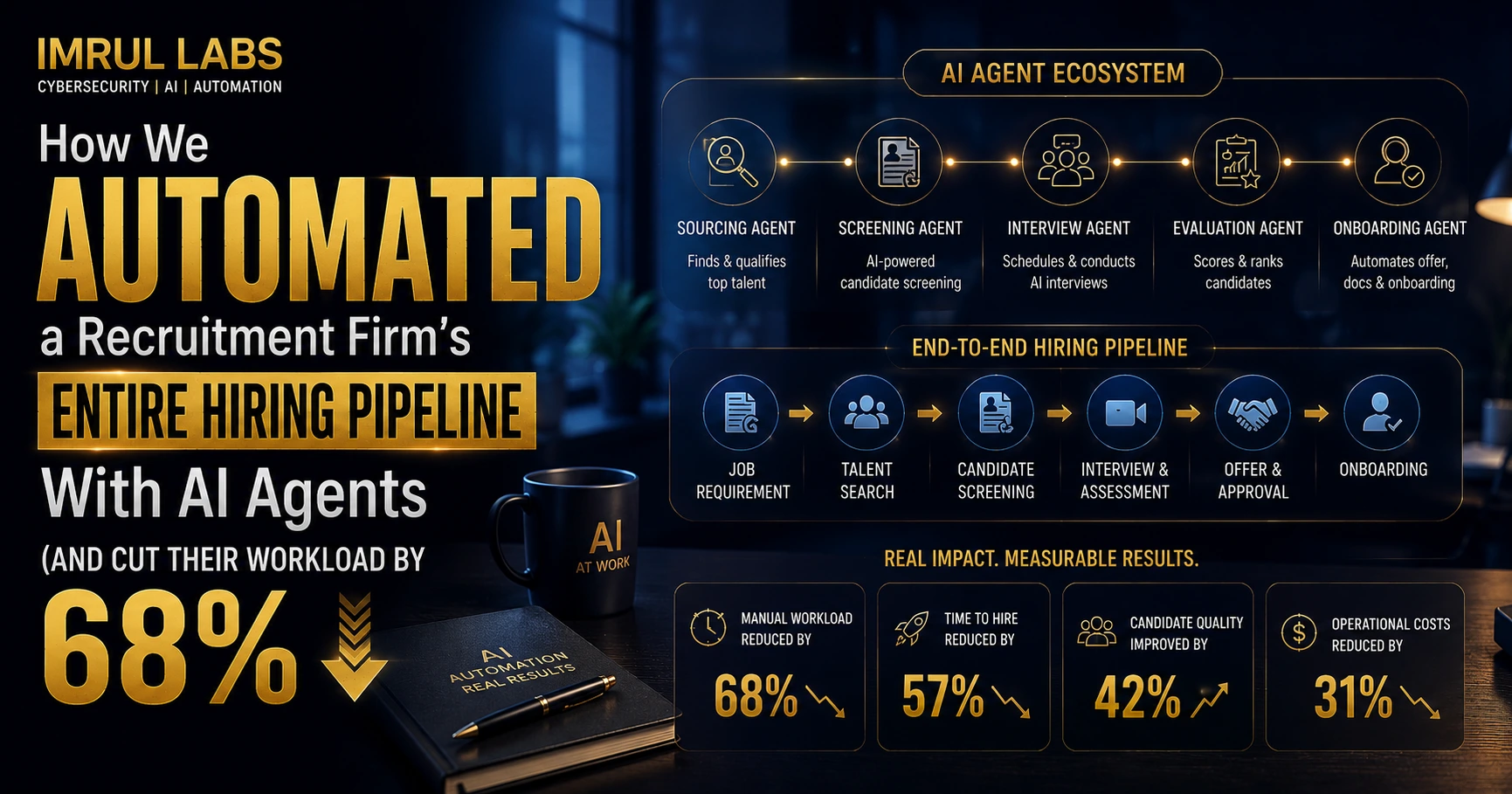
title: ‘AI Recruitment Automation: How a Staffing Firm Cut 68% Workload’ description: ‘Discover how a US staffing firm automated resume screening, outreach, and interview scheduling with AI agents — reducing admin workload by 68% and boosting placements. Book a free consultation today.’ pubDate: ‘Jun 19 2026’ heroImage: ‘/ai-automation-recruitment-firm-cover.webp’ tags: [“Case Study”, “AI Agents”, “n8n”, “Recruitment Automation”, “Staffing Firm”, “Workflow Automation”, “Agentic AI”] faq:
- question: “How much time can AI save in recruitment?” answer: “AI automation can reduce manual admin work by up to 68%, freeing recruiters to focus on sourcing and placements.”
- question: “Does AI resume screening reduce bias?” answer: “Yes. AI agents score candidates consistently against a fixed rubric every time, reducing the subjective bias and missed skills that come from manual, ad-hoc screening.”
- question: “What tools are used for recruitment automation?” answer: “We use n8n for orchestration, custom AI agents for screening and outreach, and integrations with the firm’s ATS, email platform, and scheduling tools like Calendly.”
- question: “Is my recruitment data kept confidential?” answer: “Absolutely. All client workflows, candidate data, and ATS integrations are handled under strict confidentiality. We do not share client information or project details under any circumstances.”
- question: “Is my recruitment firm ready for this?” answer: “Firms that benefit most are processing 100+ applications per role, running 5+ active roles simultaneously, or losing candidates to slow response times. If that sounds like your operation, the workflow exists — we have already built it.”
Spending 30+ hours a week on resume screening and candidate follow-ups? Book a free consultation — Imrul Labs builds AI agent systems that handle the repetitive work so your team can focus on placements.
Recruitment coordinators spend an average of 23 hours per week doing work that could be done in minutes. Resume screening, sending the same follow-up emails, manually scheduling interviews, chasing candidates who never replied — it is repetitive, it is exhausting, and it is keeping your team from doing the work that actually fills roles.
This is the story of how we built an end-to-end AI automation system for a mid-sized staffing firm, and what happened to their workflow 30 days after launch.
The Client: A Staffing Firm Drowning in Volume
Our client was a recruitment agency placing mid-senior professionals across the US tech and finance sector. They were handling 200–300 new applicants per open role, managing 8–12 active roles at any time, and running a team of 4 coordinators.
The numbers looked like this before we started:
| Task | Weekly Hours (Manual) |
|---|---|
| Resume screening & scoring | 18 hrs |
| Initial outreach emails | 8 hrs |
| Scheduling & rescheduling | 6 hrs |
| Status update follow-ups | 5 hrs |
| Total | 37 hrs/week |
That is nearly a full-time employee worth of effort spent on admin work.
The real cost was not the hours. It was what the team was not doing: building client relationships, sourcing passive candidates, and closing placements. One coordinator put it plainly:
“I spend my mornings staring at PDFs and copy-pasting the same email with different names.”
The Problem Breakdown
Before building anything, we mapped out exactly where the friction lived. Three core problems emerged.
Problem 1 — Resume screening took too long and lacked consistency. Each coordinator had their own mental model for what a “good” candidate looked like. That meant inconsistent shortlisting, bias toward certain formats, and skills being missed when a CV used different terminology. There was no scoring rubric — everything lived in someone’s head.
Problem 2 — Candidate outreach was slow and generic. Initial outreach emails were going out 48–72 hours after application, a lifetime in competitive hiring markets. Candidates were already in other processes by the time the firm replied. Worse, every email was manually written and sounded like it.
Problem 3 — Scheduling was a calendar nightmare. Coordinators were manually cross-referencing availability, sending calendar invites, handling last-minute reschedules, and sending reminders. When a candidate ghosted, there was no automated follow-up — just a coordinator noticing the blank slot at 9am.
📌 Sound familiar? Talk to us about automating your recruitment pipeline.
What We Built: The n8n + AI Agent Stack
We designed a three-layer automation pipeline using n8n as the orchestration backbone, a custom AI agent for screening and communication, and integrations with the firm’s existing ATS and email tools.
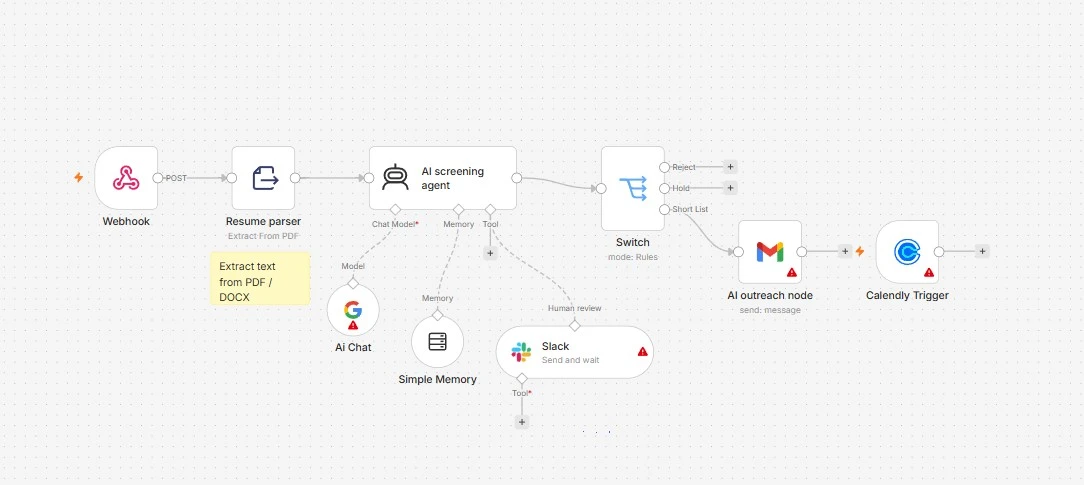
Illustrative workflow built to demonstrate the architecture. Client implementations are confidential — node names, credentials, and integrations vary per project.
Layer 1 — Intelligent resume screening. When a new application comes in, the workflow extracts the resume text, pulls the job description and scoring criteria from the ATS, and sends both to the AI agent with a structured scoring prompt. The agent returns a scored profile (0–100) with flagged skills, gaps, and a hire / pass / hold recommendation, then routes the candidate into the correct pipeline stage automatically.
The AI agent was instructed to score consistently against the same rubric every time — no mood, no bias, no Monday morning fatigue. Coordinators reviewed the top 20% and overrode where needed, but the heavy lifting was done.
Result: resume review time dropped from 18 hours to under 4 hours per week.
Layer 2 — Automated outreach with personalisation. For every shortlisted candidate, the system automatically drafts and sends a personalised outreach email within 15 minutes of screening completion. The email references specific skills from their CV, mentions the role by title, and includes a one-click scheduling link. If no response comes within 48 hours, a follow-up is sent automatically. After 72 hours with no reply, the candidate moves to a cold pool for manual review.
Result: outreach time dropped from 8 hours to near-zero. Response rates increased by 31% due to faster, more relevant messaging.
Layer 3 — Self-managing interview scheduling. Shortlisted candidates who respond are routed to a Calendly-integrated scheduling flow. The AI agent presents available slots based on interviewer availability, sends confirmation emails with prep materials, sends automated reminders at 24h and 2h before the interview, and detects no-shows to trigger a rescheduling sequence.
Result: scheduling workload dropped from 6 hours to under 30 minutes per week.
Results After 30 Days
| Metric | Before | After |
|---|---|---|
| Weekly admin hours | 37 hrs | 12 hrs |
| Time-to-first-outreach | 48–72 hrs | < 15 mins |
| Candidate response rate | 22% | 29% |
| Placements (month) | 6 | 9 |
The 68% reduction in admin workload translated directly into more placements, because coordinators had time to actually recruit instead of manage inboxes. One coordinator’s comment at the 30-day mark:
“I used to dread Monday mornings. Now the pipeline updates itself over the weekend and I start the week knowing exactly who to call.”
What This Costs to Build vs. What You Are Losing Without It
A project like this typically takes 2–3 weeks to design, build, and test, with minimal ongoing maintenance once live.
Compare that to the cost of 37 hours of coordinator time per week across the year, placement opportunities lost to slow outreach, and top candidates placed by faster-moving competitors. The ROI on a well-built AI automation stack for a recruitment firm is rarely under 10x in the first year.
Frequently Asked Questions
How much time can AI save in recruitment? AI automation can reduce manual admin work by up to 68%, freeing recruiters to focus on sourcing and placements rather than repetitive screening and follow-ups.
Does AI resume screening reduce bias? Yes. AI agents score candidates consistently against a fixed rubric every time, reducing the subjective bias and missed skills that come from manual, ad-hoc screening.
What tools are used for recruitment automation? We use n8n for orchestration, custom AI agents for screening and outreach, and integrations with the firm’s ATS, email platform, and scheduling tools like Calendly.
Is my recruitment data kept confidential? Absolutely. All client workflows, candidate data, and ATS integrations are handled under strict confidentiality. We do not share client information or project details under any circumstances.
Is my recruitment firm ready for this? Firms that benefit most are processing 100+ applications per role, running 5+ active roles simultaneously, or losing candidates to slow response times. If that sounds like your operation, the workflow exists — we have already built it.
📌 Ready to cut your admin workload? Book a free 30-minute consultation with our automation team.