Want to assess your defenses against modern AI-powered threats? Contact us — we help businesses understand and reduce their exposure to emerging attack methods.
A New Era of Cyber Threats
For years, the most effective cyberattacks required significant skill, time, and resources. Crafting a convincing phishing email, identifying vulnerabilities in a target network, writing malware that evades detection — these were tasks that separated sophisticated threat actors from opportunistic ones.
Artificial intelligence is changing this equation fundamentally.
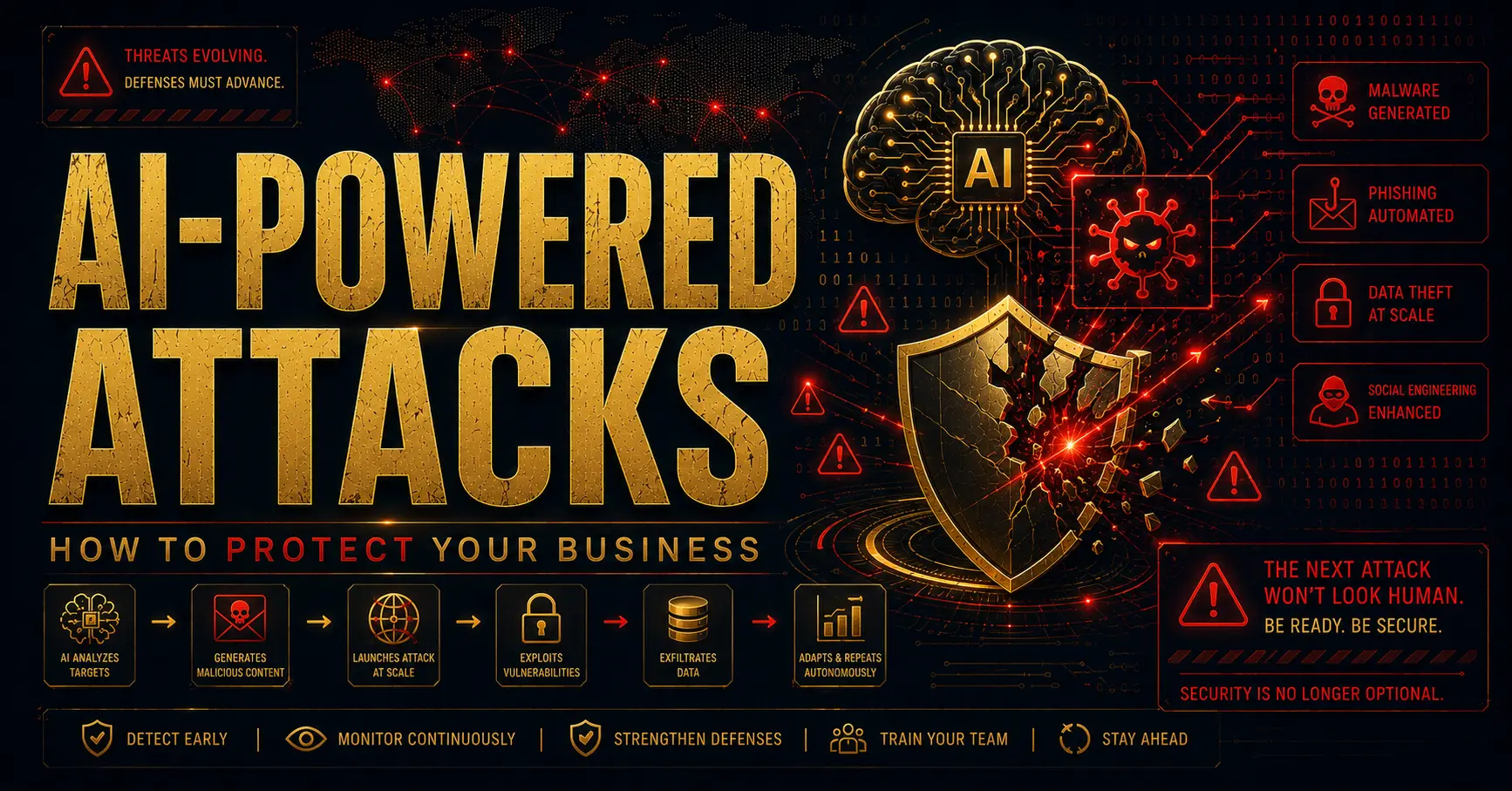
Today, capabilities that once required expert-level skills are being democratized by AI tools. Attackers can generate convincing phishing emails in seconds, automate the discovery of vulnerabilities across thousands of targets simultaneously, and adapt their malware in real time to evade detection.
The barrier to launching sophisticated cyberattacks has never been lower. Understanding how AI is being weaponized is the first step toward defending against it.
📌 Is Someone Spyware-Tracking Your Device? If your phone runs hot, your battery vanishes, or your private photos and texts feel compromised—stop wondering. Get immediate, 100% confidential proof and elimination from our Emergency Forensic Investigation & DFIR Team
Deepfakes are one of the most dangerous AI-powered attack methods. Read Deepfake Attacks Targeting Businesses.
Learn how to build your defenses with How to Build an Incident Response Plan.
How Attackers Are Using AI
AI-Generated Phishing at Scale
Traditional phishing campaigns were limited by the time required to craft convincing messages. Generic, poorly written phishing emails were easy to spot and frequently filtered by security tools.
AI has eliminated this constraint. Attackers now use large language models to generate highly personalized, grammatically perfect phishing emails at scale. These emails reference real events, mimic the writing style of legitimate communications, and are tailored to the specific recipient based on information gathered from social media and other public sources.
The result is phishing emails that are significantly harder for both humans and automated filters to identify as malicious.
Automated Vulnerability Discovery
Finding vulnerabilities in a target system previously required significant manual effort. Attackers had to understand the target environment, identify potential weaknesses, and test them individually.
AI-powered scanning tools can now automate this process at a scale and speed that was previously impossible. These tools can analyze thousands of targets simultaneously, identify patterns that suggest exploitable weaknesses, and prioritize the most promising attack paths.
Organizations that were previously protected by the simple fact that attackers had limited time and resources to investigate them are no longer as safe.
Adaptive Malware
Traditional malware uses fixed code that security tools learn to recognize and block. Modern AI-powered malware can modify its own code and behavior to evade detection, adapting in real time based on the security controls it encounters.
This creates a significant challenge for signature-based detection tools, which rely on recognizing known malicious patterns. An AI-powered malware sample that rewrites itself each time it executes may not match any known signature.
Deepfake Social Engineering
AI-generated audio and video are now convincing enough to impersonate individuals in real time. Attackers are using deepfake technology to conduct voice phishing attacks where they impersonate executives, vendors, or IT staff to manipulate employees into transferring funds, sharing credentials, or bypassing security controls.
Several high-profile fraud cases have already involved attackers using AI-generated audio to impersonate company leadership during phone calls.
AI-Assisted Credential Attacks
AI models trained on breach data can generate highly targeted password guesses based on what is known about the target — their name, birthday, employer, and patterns from previously compromised accounts. This makes credential stuffing and password spraying attacks significantly more effective.
Why Traditional Defenses Are No Longer Enough
Most organizations built their security posture around a threat landscape that no longer exists. The controls that were adequate against the attacks of five years ago are increasingly insufficient against AI-powered threats.
Signature-based detection struggles against adaptive malware that modifies itself to avoid known signatures.
Email filtering based on known phishing patterns misses AI-generated emails that do not match existing templates.
Security awareness training that teaches employees to spot obvious phishing signs is less effective when phishing emails are indistinguishable from legitimate communications.
Perimeter defenses designed to block known malicious IPs and domains are easily circumvented by attackers who rotate infrastructure rapidly.
This does not mean these controls are worthless. It means they are necessary but no longer sufficient. Organizations need to layer additional defenses designed for the current threat environment.
How to Protect Your Business
Implement Behavioral Detection
Move beyond signature-based detection to behavioral analysis. Rather than looking for known malicious patterns, behavioral detection identifies anomalies in how systems and users behave — catching threats that have never been seen before.
Modern endpoint detection and response (EDR) tools use behavioral analysis to identify suspicious activity even when the specific malware or technique has not been seen before.
Strengthen Identity Security
Credential compromise is one of the most common entry points for attackers, and AI-powered credential attacks are making this worse. Strengthening identity security is one of the highest-impact investments you can make.
Key measures include:
- Multi-factor authentication on all accounts, particularly email, VPN, and administrative access
- Phishing-resistant MFA methods where possible
- Regular monitoring for compromised credentials in breach databases
- Privileged access management to limit what compromised credentials can access
Verify All High-Risk Requests
Deepfake attacks targeting employees with requests for fund transfers, credential sharing, or other high-risk actions require a verification step that cannot be bypassed by a convincing voice or video call.
Implement out-of-band verification procedures for any request involving financial transactions, credential changes, or access to sensitive systems. A simple callback to a known number using contact information from your internal directory can defeat many social engineering attacks.
Use AI to Fight AI
The most effective defense against AI-powered attacks is AI-powered defense. Security tools that use machine learning and AI to analyze behavior, detect anomalies, and correlate signals across your environment are significantly more effective against modern threats than tools built on static rules and signatures.
AI-powered security tools can:
- Detect phishing emails based on behavioral signals rather than known patterns
- Identify anomalous user and system behavior that may indicate compromise
- Correlate events across your environment to surface attack patterns that would be invisible when looking at individual alerts
- Respond to confirmed threats automatically to reduce the time attackers have to cause damage
Conduct Regular Security Assessments
Understanding your actual exposure to AI-powered threats requires testing. Regular penetration testing and security assessments help you identify weaknesses before attackers do, and verify that your defenses are working as intended.
Given the pace at which attack techniques are evolving, assessments should be conducted at least annually and after significant changes to your environment.
Invest in Security Awareness Training
While AI-generated phishing is harder to detect, well-trained employees remain one of your most important defenses. Update your training to address current threats, including:
- How to recognize AI-generated phishing even when it appears convincing
- Verification procedures for high-risk requests
- How to report suspicious activity quickly
- The role every employee plays in your security posture
Develop an Incident Response Capability
When defenses fail — and against sufficiently sophisticated attackers, they eventually will — your ability to detect, contain, and recover from an incident determines the outcome. Organizations with mature incident response capabilities suffer significantly less damage from breaches than those without.
This means having a documented incident response plan, trained responders, and the tools and access needed to investigate and contain incidents quickly.
The Defender’s Advantage
While the threat landscape is evolving rapidly, defenders have significant advantages that attackers do not.
You know your own environment. You can instrument it, monitor it, and build detection capabilities tailored to your specific systems and users. Attackers are operating in the dark, trying to understand an environment they have never seen before.
You can share intelligence. The security community shares threat intelligence, attack techniques, and defensive strategies in ways that the criminal community cannot. Information about new attack methods spreads through the defender community and enables rapid adaptation.
You can invest in resilience. The goal is not to achieve perfect security — that does not exist. The goal is to make attacking your organization more difficult and expensive than the attacker is willing to invest, and to recover quickly when incidents do occur.
How ImrulLabs Can Help
At ImrulLabs, we help organizations understand and defend against modern threats, including AI-powered attack techniques. Our services span threat intelligence, security assessments, incident response, and AI-powered security automation.
Whether you want to assess your current exposure, strengthen your defenses, or build the incident response capability to handle a breach when it occurs, get in touch for a free consultation.