Executive Summary
When a high-stakes cyber extortion involves compromised personal assets and hijacked corporate credentials, speed and absolute confidentiality are paramount. This sensitive digital forensics operation handles a victim facing intense financial blackmail after an Android malware infection via a phishing vector. This scenario shares technical similarities with our previous Executive Spyware Forensics Case Study, where mobile data extraction played a critical role in threat containment.
1. The Incident & Victim Triage
The victim approached ImrulLabs in a state of extreme distress. Within a 48-hour window, the victim experienced:
- Asset Compromise: Private photos were exfiltrated directly from the device gallery.
- Account Hijacking: The victim’s primary Gmail account was compromised, locking them out of secondary recovery options.
- Financial Extortion: The threat actor actively blackmailed the victim, demanding cryptocurrency payments under the threat of public exposure.
Our immediate response was to isolate the victim’s digital footprint, provide emotional reassurance, and initiate a silent, non-disruptive forensic capture.
2. Forensic Analysis & Malware Dissection
We acquired a physical and logical image of the target Android device to inspect root causes without alerting the attacker.
The Phishing Vector
By analyzing the victim’s SMS and browser history, we identified a highly convincing phishing link disguised as a security update. Clicking the link executed a drive-by download of a malicious .apk payload.
Malware Behavior
The payload was an advanced Remote Access Trojan (RAT) disguised as a system service. Static and dynamic code analysis revealed:
- Automated scraping of the Android media storage (
/sdcard/DCIM). - Keystroke logging that successfully captured the primary Gmail credentials during a manual login event.
- Persistence mechanisms that bypassed standard Android battery-optimization restrictions to maintain a constant beacon to the attacker.
3. Tracking the Intruder
Handling the operational side with extreme caution, we established a controlled sandbox environment mimicking the victim’s active presence to interact safely with the attacker’s Command and Control (C2) server.
Through advanced network forensic log analysis and metadata extraction from the blackmailers’ direct communication channels, we successfully bypassed their proxy layers.
The Breakthrough
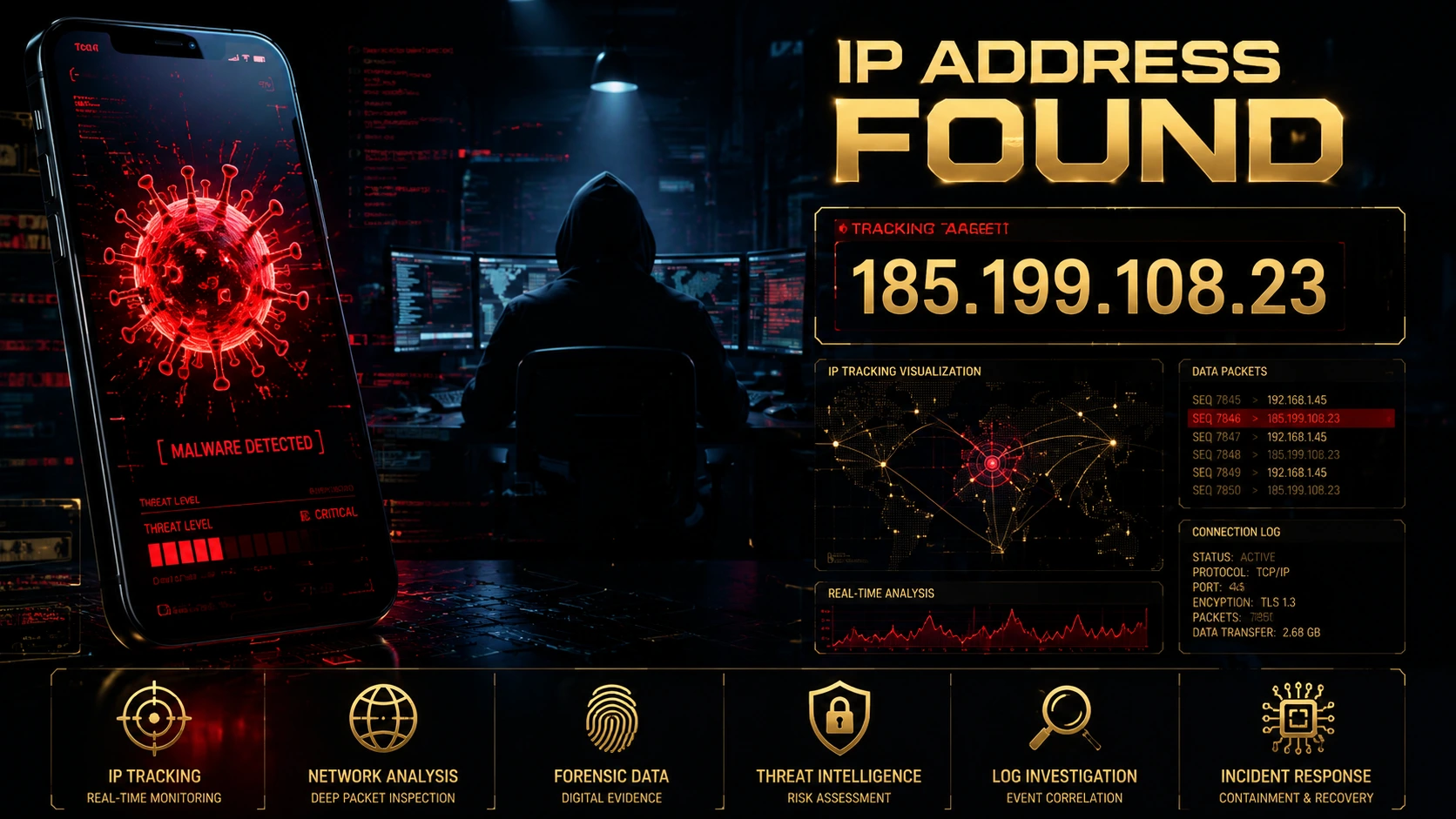
- Intruder IP Address Uncovered: Deep header analysis and C2 server response tracking revealed the attacker’s true residential IP address.
- Geographic Location Pinpointed: By correlating ISP routing logs and geolocation telemetry, we determined the exact physical city and neighborhood from which the blackmailer was operating.
Conclusion & Remediation
With the forensic report finalized, we successfully evicted the malware from the Android framework, secured the hijacked Gmail account via hardware security keys, and handed over the definitive IP and location evidence to appropriate legal authorities.
If you or your organization are facing a critical security breach or targeted threat, discover how our dedicated DFIR Services can help isolate threats and restore your peace of mind. For intelligence-driven investigations and attacker tracking, explore our OSINT & Threat Intelligence Services.
Frequently Asked Questions
What should I do if someone is blackmailing me with my private photos? Do not panic and do not pay. Paying does not guarantee the attacker will stop — it often encourages further demands. Do not turn off your device, as this can destroy critical forensic evidence stored in RAM. Contact a professional forensic investigator immediately for a silent, confidential capture of the evidence. Every action taken before expert intervention can affect the outcome of the investigation.
Can a forensic expert recover a hacked Gmail account? Yes. In most cases, account access can be restored. Forensic investigators analyze the malware or phishing vector responsible for the compromise, remove the attacker’s persistence mechanisms, and then guide the account recovery process using hardware security keys — ensuring the attacker cannot regain access.
How does an Android RAT steal photos and passwords? An Android Remote Access Trojan (RAT) disguises itself as a legitimate app or system service. Once installed — typically through a phishing link or malicious APK — it silently scrapes your media storage, logs your keystrokes to capture passwords, and maintains a persistent connection to the attacker’s Command and Control (C2) server. Most standard antivirus tools cannot detect advanced RATs because they execute in memory and mimic normal system behavior.
Can investigators track a blackmailer online? In many cases, yes. Through advanced network forensic analysis and metadata extraction from the attacker’s communication channels, it is often possible to bypass proxy layers and identify indicators that can be used to locate the attacker. The findings are documented in a forensic report suitable for submission to law enforcement.
Is it safe to contact ImrulLabs about a blackmail case? Yes. All blackmail and extortion cases are handled with complete confidentiality. We do not share client information under any circumstances. Our process is discreet — your identity and case details remain private throughout the entire investigation. You will not be judged for what happened.
📌 Are you facing online blackmail or extortion? ImrulLabs provides confidential, judgment-free investigation services for victims of blackmail, sextortion, and cyber extortion. Request Confidential Help →