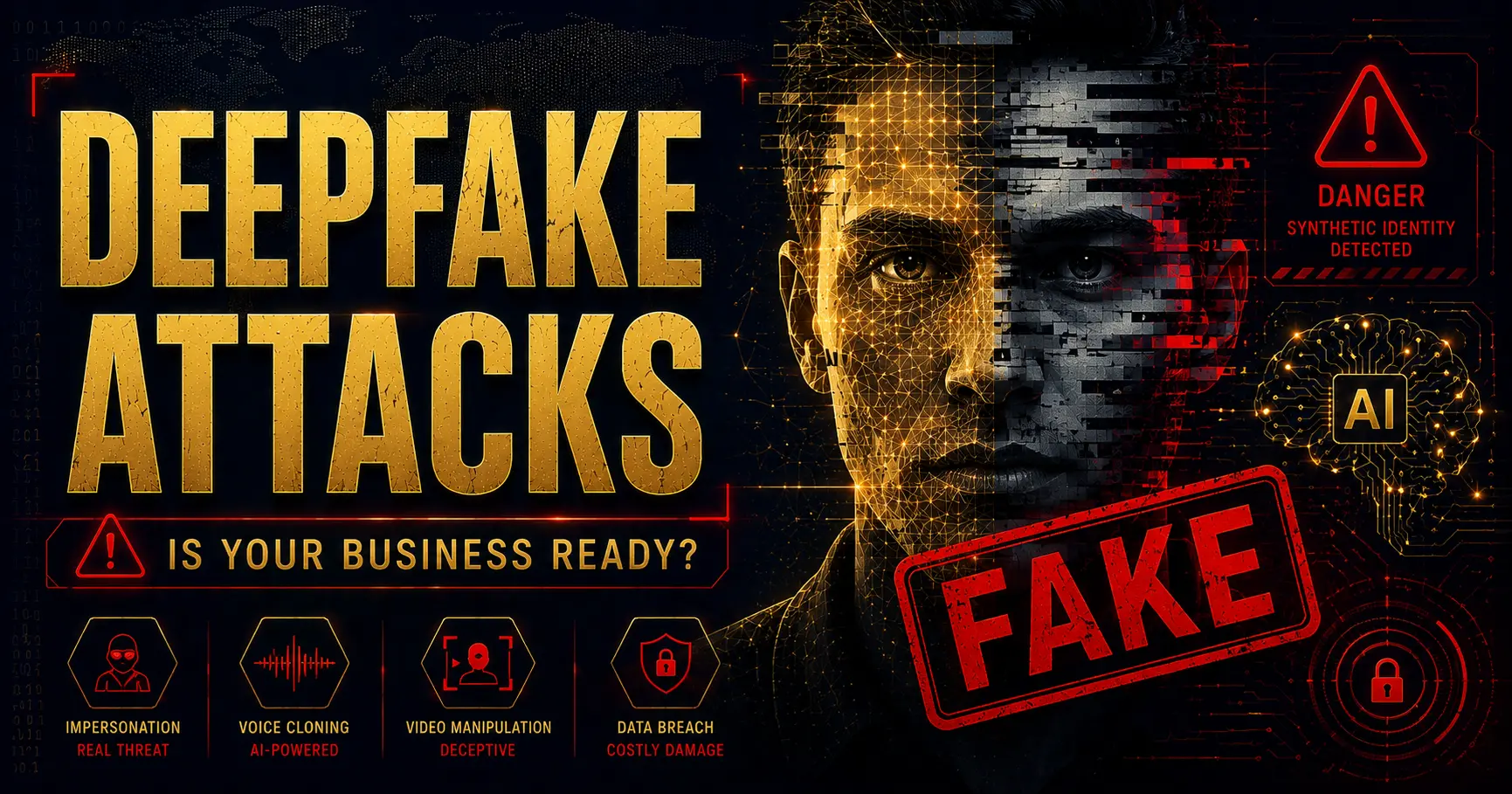
Concerned about deepfake threats targeting your organization? Contact us — we help businesses assess and defend against AI-powered social engineering attacks.
The Threat No One Saw Coming
A finance executive at a US multinational received a video call from what appeared to be the company’s CFO. The CFO, visible on screen, requested an urgent wire transfer of $25 million to complete a confidential acquisition. The executive complied.
The CFO never made that call. The entire interaction was a deepfake — an AI-generated video and voice so convincing that a senior finance professional saw no reason to question it.
This incident, reported in early 2024, is not an isolated case. It is a preview of what is becoming one of the most dangerous and rapidly growing threats facing US businesses today.
Discover how attackers exploit machine learning in AI-Powered Cyberattacks, and make sure your team is ready by mastering How to Build an Incident Response Plan.
📌 Under Attack? If you suspect a breach or an active exploit, don’t wait—get instant, confidential expert help from our Emergency Incident Response & Forensic Investigation.
What Are Deepfakes?
Deepfakes are AI-generated synthetic media — video, audio, or images — that convincingly replicate the appearance and voice of real individuals. The technology uses deep learning models trained on existing footage and recordings to generate new content that is increasingly indistinguishable from genuine media.
What began as a technology requiring significant computational resources and expertise is now accessible to anyone with a consumer-grade computer and an internet connection. Commercial deepfake tools are widely available, and the quality of AI-generated audio has reached a point where voice cloning can be achieved from as little as a few seconds of recorded speech.
For businesses, this creates a threat that traditional security controls were never designed to address.
How Attackers Are Using Deepfakes Against US Businesses
Executive Impersonation Fraud
The most financially damaging deepfake attacks involve impersonating senior executives — CEOs, CFOs, and board members — to authorize fraudulent wire transfers, change banking details, or approve unauthorized transactions.
Attackers research their targets using publicly available information — earnings calls, conference presentations, media interviews — to gather sufficient audio and video to create convincing deepfakes. The attack is then delivered via video call, voicemail, or phone call to employees who have authority to execute financial transactions.
US companies lose billions annually to business email compromise. Deepfake voice and video attacks represent a significant escalation of this threat.
IT and Security Bypass
Attackers are using AI-generated voices to impersonate IT staff or security personnel in calls to employees. The goal is to manipulate employees into resetting passwords, sharing credentials, disabling security controls, or providing access to systems.
These attacks are particularly effective because they exploit the natural trust employees place in requests from IT and security teams, especially when those requests appear to come from a recognizable voice.
Vendor and Partner Impersonation
Beyond internal impersonation, attackers are using deepfakes to impersonate trusted vendors, partners, and clients. A convincing call from what sounds like a long-standing vendor requesting a change to banking details is a highly effective fraud vector that has cost US businesses significant sums.
HR and Recruitment Fraud
The FBI has issued warnings about the use of deepfake video in remote job interviews. Attackers apply for positions — particularly remote roles with access to sensitive systems or data — using AI-generated video to impersonate the candidate during interviews.
Once hired, the fraudulent employee has legitimate access to company systems, which can be exploited for data theft, espionage, or to facilitate further attacks.
Why US Businesses Are Particularly Vulnerable
Several factors make US businesses attractive and vulnerable targets for deepfake attacks.
High-value targets. US companies handle significant financial transactions, hold valuable intellectual property, and operate critical infrastructure — making successful attacks extremely lucrative.
Remote work culture. The shift to remote work has normalized video calls and reduced the frequency of in-person verification. Employees are accustomed to conducting business entirely through digital channels, which attackers exploit.
Public information availability. US executives are heavily documented online — earnings calls, conference talks, media interviews, social media — providing attackers with abundant material to train deepfake models.
Rapid business pace. The urgency culture in US business — where executives expect immediate responses to requests — creates pressure on employees to act quickly without taking time to verify.
The Detection Problem
Deepfake detection technology exists, but it faces a fundamental challenge: the gap between generation and detection capability consistently favors the attacker.
As detection tools improve, generation models are updated to defeat them. Automated detection tools have meaningful false positive and false negative rates. And in real-time voice and video calls, there is no opportunity to run content through a detection tool before responding.
This means that technical detection alone is not a sufficient defense. Organizational processes and human judgment must be the primary line of defense.
How to Protect Your Business
Implement Verification Protocols for High-Risk Requests
Any request involving financial transactions, credential changes, access to sensitive systems, or modifications to vendor payment details should require out-of-band verification — a callback to a known, pre-verified number using contact information from your internal directory, not information provided in the suspicious communication.
This single control defeats the majority of deepfake fraud attempts. An attacker who has crafted a convincing deepfake cannot control what happens when you hang up and call back on a number you already have.
Establish a Code Word System
For organizations where executives regularly communicate sensitive instructions, establish a code word or challenge-response system for high-value requests. A legitimate executive will know the code word. A deepfake will not.
This low-tech control is highly effective and costs nothing to implement.
Train Employees to Recognize the Threat
Security awareness training must be updated to address deepfake threats specifically. Employees need to understand:
- That deepfake technology exists and is being used in fraud
- That video and voice calls can be faked convincingly
- That urgency and authority are common manipulation tactics
- That verification is always appropriate, regardless of who appears to be asking
Training should include real examples of deepfake attacks and practice scenarios that build the habit of verification.
Limit Publicly Available Executive Media
While you cannot eliminate publicly available footage of executives, you can be deliberate about what is published. Long recordings of executive voices — earnings calls, conference presentations, video interviews — provide attackers with the material needed to create convincing voice clones.
Consider watermarking or limiting distribution of high-quality audio and video content featuring senior leadership.
Implement Strong Identity Verification for Remote Hiring
Given the FBI warnings about deepfake use in remote interviews, strengthen your hiring process for remote positions with access to sensitive systems:
- Require government ID verification through a trusted third-party service
- Conduct at least one video interview with specific liveness checks
- Verify references through independently sourced contact information
- Consider background checks that include identity verification components
Develop an Incident Response Plan for Deepfake Fraud
If a deepfake attack succeeds, having a pre-defined response plan minimizes damage. Your plan should address:
- Immediate steps to attempt to reverse fraudulent transactions
- Who to notify internally and externally
- Law enforcement reporting procedures
- Communication with affected vendors, partners, or clients
- Forensic preservation of evidence
The Broader Implications
Deepfake attacks on businesses are not a future threat. They are happening now, they are increasing in frequency and sophistication, and the technology that enables them is becoming more accessible every month.
The organizations that recognize this threat and build appropriate defenses — verification protocols, employee training, and incident response capability — will be significantly better positioned than those that continue to rely on controls designed for a pre-deepfake threat landscape.
The question is not whether your organization will face a deepfake-based attack. It is whether you will be ready when it happens.
How ImrulLabs Can Help
At ImrulLabs, we help US and international businesses assess their exposure to AI-powered social engineering threats, including deepfake attacks. Our services include security assessments, employee training program development, and incident response planning.
Get in touch for a free consultation to discuss how your organization can prepare for deepfake threats.