Need help building your incident response plan? Contact us — we develop custom IR plans and playbooks for businesses globally.
Why Most Businesses Are Not Ready for a Cyberattack
Ask most business owners whether they have an incident response plan and you will get one of two answers. Either a confident yes followed by a vague description of what their IT team would do, or an honest admission that they do not have one.
Both situations are problematic.
A vague, untested plan provides a false sense of security. And no plan at all means your team will be improvising during one of the most stressful and consequential events your organization can face.
The cost of that improvisation is significant. Organizations with a tested incident response plan contain breaches 54 days faster on average than those without one, and the financial impact is substantially lower.
This guide walks you through exactly how to build an incident response plan that prepares your organization for the reality of modern cyberattacks.
📌 Emergency Support: Under attack or suspect you have been hacked? Get instant, confidential expert help with our Emergency Incident Response & Forensic Investigation.
To eliminate manual overhead and block threats 24/7, learn how to upgrade your defenses in How to Automate Security Operations.
📌 Need Expert Help? Talk to our certified team today for Custom AI & Cyber Security Automation Services.
What is an Incident Response Plan?
An incident response plan (IRP) is a documented, structured approach to detecting, containing, eradicating, and recovering from security incidents. It defines who does what, when, and how when something goes wrong.
A good incident response plan answers these questions before an incident occurs:
- What counts as a security incident requiring a formal response?
- Who is responsible for leading the response?
- How do we communicate internally and externally during an incident?
- What steps do we take to contain and eradicate a threat?
- How do we recover and return to normal operations?
- What do we learn from each incident to improve our defenses?
Without clear answers to these questions, your team will waste precious time figuring them out during a crisis.
The Six Phases of Incident Response
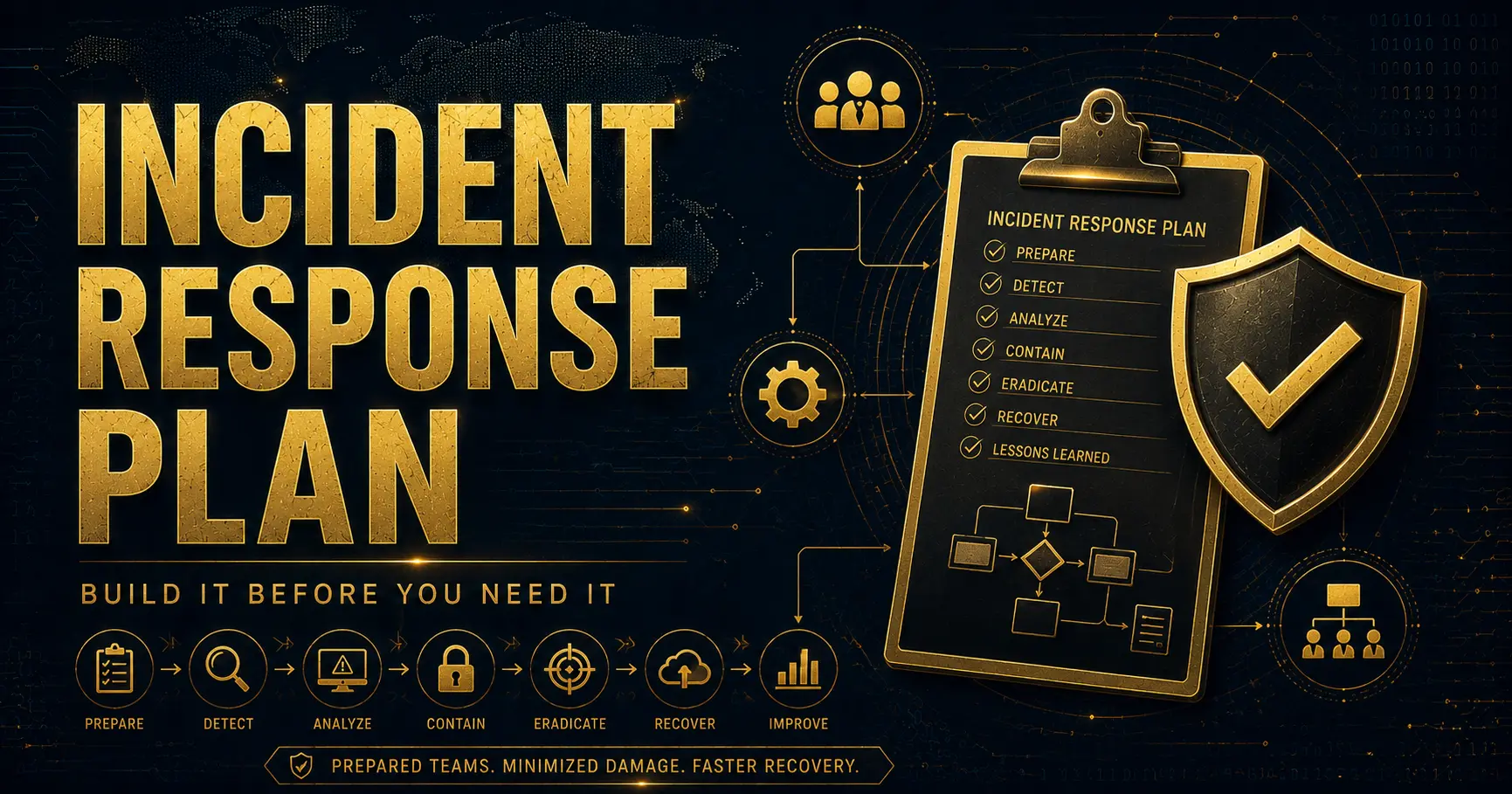
Most incident response frameworks, including those published by NIST and SANS, organize the response process into six phases. Your plan should address each one.
Phase 1: Preparation
Preparation is the foundation of effective incident response. This is everything you do before an incident occurs.
Preparation includes:
- Defining what constitutes a security incident for your organization
- Establishing your incident response team and their roles
- Documenting communication procedures and escalation paths
- Ensuring your team has the tools and access they need to respond
- Conducting tabletop exercises to test your plan
- Building relationships with external resources such as legal counsel and IR firms
Most organizations spend too little time on preparation and too much time reacting. Investing in preparation is where the greatest return on incident response capability comes from.
Phase 2: Identification
Identification is the process of detecting and confirming that a security incident has occurred. This phase answers the question: is this actually an incident?
Not every alert is an incident, and not every incident starts with an alert. Effective identification requires:
- Security monitoring tools that provide visibility across your environment
- Defined criteria for what constitutes an incident worth investigating
- A clear process for escalating potential incidents to the response team
- Documentation of when the incident was discovered and what was initially observed
The faster you identify a genuine incident, the less damage it can cause. This is why security monitoring is so closely tied to incident response capability.
Phase 3: Containment
Once an incident is confirmed, the immediate priority is stopping it from spreading. Containment is typically divided into two stages.
Short-term containment focuses on stopping the immediate damage. This might mean isolating affected systems from the network, disabling compromised accounts, or blocking malicious IP addresses.
Long-term containment involves more deliberate measures that allow business operations to continue while a full investigation takes place. This might involve moving to backup systems, implementing additional monitoring, or restricting access to sensitive data.
Containment decisions must balance the need to stop damage against the risk of destroying forensic evidence. This is one of the reasons having experienced responders involved early is so valuable.
Phase 4: Eradication
Eradication means removing the threat from your environment completely. This goes beyond containment and involves:
- Identifying and removing all malware and attacker tooling
- Closing the vulnerability or entry point that allowed the attack
- Removing any unauthorized accounts or access the attacker established
- Verifying that no persistence mechanisms remain
Incomplete eradication is one of the most common causes of repeat incidents. Attackers frequently establish multiple footholds, and removing only the obvious one while missing others leads to reinfection.
Phase 5: Recovery
Recovery involves restoring affected systems and returning to normal operations. This phase includes:
- Restoring systems from clean backups
- Verifying that restored systems are clean before reconnecting them to the network
- Monitoring restored systems closely for signs of reinfection
- Communicating with stakeholders about the recovery timeline
Recovery is often slower than organizations expect, particularly when backups are incomplete or were themselves compromised during the attack.
Phase 6: Lessons Learned
The final phase is one of the most valuable and most frequently skipped. A post-incident review allows your organization to understand what happened, why, and what needs to change.
A structured lessons learned session should document:
- The root cause of the incident
- What detection mechanisms worked and what failed
- What response actions were effective and what caused delays
- What changes to security controls, processes, or training are needed
- Updates required to the incident response plan itself
Each incident, however painful, is an opportunity to meaningfully improve your security posture.
Building Your Incident Response Team
Your incident response plan is only as good as the people responsible for executing it. Define your incident response team clearly, including:
Incident Response Lead — responsible for coordinating the overall response and making key decisions
Technical Responders — IT and security staff who perform the hands-on investigation and remediation work
Communications Lead — responsible for internal and external communications during the incident
Legal Counsel — advises on regulatory obligations, liability, and any law enforcement involvement
Executive Sponsor — senior leadership representative with authority to approve significant decisions
For smaller organizations, one person may fill multiple roles. What matters is that these responsibilities are assigned before an incident occurs, not improvised during one.
Developing Response Playbooks
A general incident response plan provides the framework. Playbooks provide the specific, step-by-step procedures for responding to particular types of incidents.
Every organization should have playbooks for at least:
- Ransomware attacks
- Data breaches involving personal information
- Business email compromise
- Denial of service attacks
- Insider threats
Playbooks remove the need for improvisation during high-stress situations. They are the difference between a team that knows exactly what to do and one that is figuring it out in real time.
Testing Your Plan
A plan that has never been tested is a plan you cannot trust. Regular testing is essential.
Tabletop exercises are discussion-based sessions where your team walks through a simulated incident scenario. They are low-cost, low-disruption, and highly effective at identifying gaps in your plan and building team familiarity with the response process.
Technical exercises involve actually simulating incident conditions in a controlled environment. These are more resource-intensive but provide a higher level of confidence in your response capability.
Aim to conduct at least one tabletop exercise per year, and update your plan after each exercise to incorporate what you learned.
Common Mistakes to Avoid
Not assigning clear ownership — if everyone is responsible, no one is. Every role in your plan must have a named individual or team responsible for it.
Keeping the plan in one location — if your incident response plan is stored only on a system that gets encrypted during a ransomware attack, it is useless when you need it most. Keep physical copies and offline backups.
Never testing the plan — a plan that has never been exercised will fail when it matters. Test regularly.
Not updating the plan — your environment changes, your team changes, and the threat landscape changes. Review and update your plan at least annually.
Forgetting communication procedures — who do you call? In what order? What do you say to clients, regulators, and the press? These questions need answers before an incident, not during one.
How ImrulLabs Can Help
Building an effective incident response plan requires expertise in both cybersecurity and organizational processes. At ImrulLabs, we help organizations develop, test, and refine their incident response capabilities through:
- Custom IR plan development tailored to your organization
- Response playbooks for specific incident types
- Tabletop exercises to test and improve your plan
- Post-incident reviews and lessons learned facilitation
Get in touch to discuss how we can help build your incident response capability.