Want to know what attackers can find out about your organization? Contact us — we offer OSINT assessments to identify your external exposure.
What Attackers Know About You Before They Attack
Before a sophisticated attacker launches a single exploit, they spend hours — sometimes days — gathering information about their target. They study your organization’s structure, map your technology stack, identify your employees, and look for weaknesses in your public-facing infrastructure.
The disturbing part? Almost everything they need is publicly available.
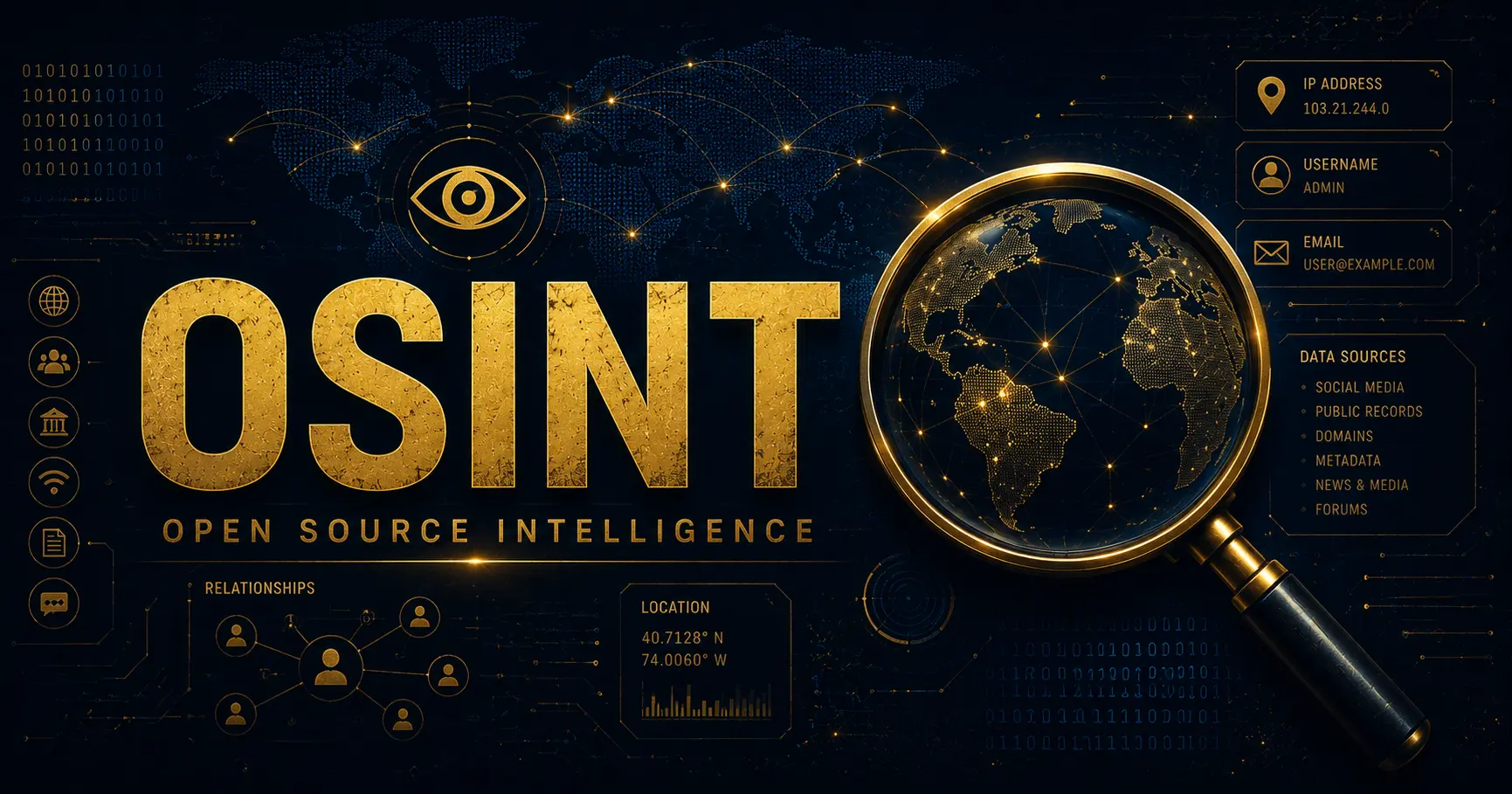
This intelligence-gathering phase is called OSINT — Open Source Intelligence — and understanding how it works is the first step toward defending against it.
They study your organization’s structure, map your technology stack, identify your employees, and look for weaknesses in your public-facing infrastructure.
📌 Related: What is DFIR? A Complete Guide to Digital Forensics and Incident Response | Personal Cyber Investigation Services Emergency DFIR Help
📌 Learn how AI is being used to automate OSINT attacks in our article on AI-Powered Cyberattacks.
What is OSINT?
OSINT stands for Open Source Intelligence. It refers to the collection and analysis of information from publicly available sources to produce actionable intelligence.
The term originated in military and intelligence communities, where analysts gathered information from newspapers, radio broadcasts, and public government records. In the digital age, the volume and accessibility of open-source information has grown exponentially.
For cybersecurity professionals, OSINT is a legitimate and essential discipline — used in penetration testing, threat intelligence, fraud investigation, and incident response. For attackers, it is a powerful reconnaissance tool that requires no technical exploits and leaves virtually no trace.
Where Does OSINT Data Come From?
The amount of information publicly available about any organization or individual is staggering. OSINT data sources include:
Search Engines
Google, Bing, and specialized search engines can reveal an enormous amount about a target — cached pages, indexed documents, exposed login panels, and misconfigured servers. Advanced search operators allow attackers to find specific file types, exposed directories, and sensitive information that organizations did not intend to make public.
Social Media and Professional Networks
LinkedIn alone can reveal an organization’s entire structure — employee names, job titles, technologies they work with, office locations, and recent hires. Attackers use this information to craft targeted phishing emails, identify key personnel to impersonate, and understand internal workflows.
Domain and IP Intelligence
Tools like WHOIS, Shodan, and Censys allow anyone to query information about domains and IP addresses — including registration details, hosting providers, SSL certificates, open ports, and running services. An attacker can map your entire internet-facing infrastructure without sending a single packet to your systems.
Data Breach Databases
Billions of credentials from historical data breaches are publicly available or sold cheaply on dark web forums. Attackers routinely check whether your employees’ email addresses and passwords appear in these databases — and then attempt to use those credentials against your systems.
Job Postings
This is one of the most underestimated OSINT sources. Job postings reveal the technologies your organization uses, the security tools you have deployed, and the gaps in your current team. An attacker who sees you are hiring a “Splunk administrator” knows you are running Splunk — and can research known vulnerabilities in that platform.
Public Documents and Metadata
PDFs, Word documents, and other files posted on your website often contain metadata — author names, software versions, internal file paths, and network information. This data can be extracted and used to build a detailed picture of your internal environment.
How Attackers Use OSINT in Practice
Understanding the reconnaissance process helps illustrate why OSINT is so powerful.
Step 1: Target Identification The attacker defines their target and begins gathering basic information — domain names, IP ranges, organizational structure, and key personnel.
Step 2: Infrastructure Mapping Using tools like Shodan and certificate transparency logs, the attacker maps all internet-facing assets — web servers, email servers, VPNs, cloud storage, and any exposed services.
Step 3: Employee Profiling LinkedIn, company websites, and social media are used to identify employees — particularly those in IT, finance, and executive roles. Email formats are identified, and employee credentials are checked against breach databases.
Step 4: Vulnerability Research With the technology stack identified from job postings, LinkedIn profiles, and web application fingerprinting, the attacker researches known vulnerabilities in the specific software versions your organization is running.
Step 5: Attack Planning Armed with a comprehensive picture of your organization, the attacker designs a targeted attack — a phishing email crafted to appear legitimate to a specific employee, an exploit targeting a known vulnerability in your web application, or a credential stuffing attack against your VPN.
All of this happens before a single attack is launched. And none of it requires breaking any laws.
What Can Attackers Find Out About Your Organization?
To make this concrete, here is what a skilled OSINT analyst can typically discover about a mid-sized business in a few hours: → All internet-facing systems and their software versions → Employee names, email addresses, and job roles → Technologies and security tools in use → Credentials from historical data breaches → Internal document metadata revealing network structure → Cloud storage buckets that may be misconfigured → Subsidiaries, partners, and supplier relationships → Financial information from public filings → Physical office locations and security camera placements This level of information gives an attacker a significant advantage before the attack even begins.
How to Reduce Your OSINT Exposure
While you cannot make your organization invisible, you can significantly reduce the amount of useful information available to attackers.
Audit Your Public Footprint Regularly search for your organization online as an attacker would. What can you find? What should not be publicly visible?
Minimize Information in Job Postings Avoid specifying exact technology versions or security tools in job postings. Describe requirements in general terms where possible.
Review Document Metadata Before publishing documents on your website, strip metadata using appropriate tools. Many organizations inadvertently expose internal information through document metadata.
Monitor Breach Databases Regularly check whether your organization’s email domains appear in known data breaches. Services exist that can alert you when new credentials are discovered.
Conduct Regular OSINT Assessments The most effective way to understand your exposure is to conduct a structured OSINT assessment — viewing your organization through an attacker’s eyes and identifying what information is available and how it could be used.
OSINT as a Defensive Tool
It is important to emphasize that OSINT is not inherently malicious. Security professionals use the same techniques and tools for legitimate defensive purposes:
- Threat intelligence — understanding who is targeting your industry and how
- Incident response — tracing attackers and understanding their infrastructure
- Vulnerability management — identifying exposed assets before attackers do
- Brand protection — detecting impersonation, phishing domains, and leaked credentials
At ImrulLabs, OSINT is a core component of our threat intelligence and security assessment services. We help organizations understand their external exposure and take action before attackers can exploit it.
Conclusion
OSINT is one of the most powerful and underappreciated elements of modern cyberattacks. Attackers invest significant time in reconnaissance precisely because the information available is so valuable — and gathering it is entirely risk-free for them.
Understanding what information is publicly available about your organization, and taking steps to minimize unnecessary exposure, is a critical component of a mature security posture.
Get in touch to discuss an OSINT assessment for your organization.