Want to build a custom AI agent for your business or security operations? Contact us — we design and deploy AI agents tailored to your specific needs.
The Shift from AI Tools to AI Agents
For most of its history, artificial intelligence has functioned as a tool. You give it an input, it produces an output. A spam filter classifies an email. An image recognition model identifies objects in a photo. A language model generates text in response to a prompt.
These are powerful capabilities. But they share a fundamental limitation: they require a human to direct every step of the process.
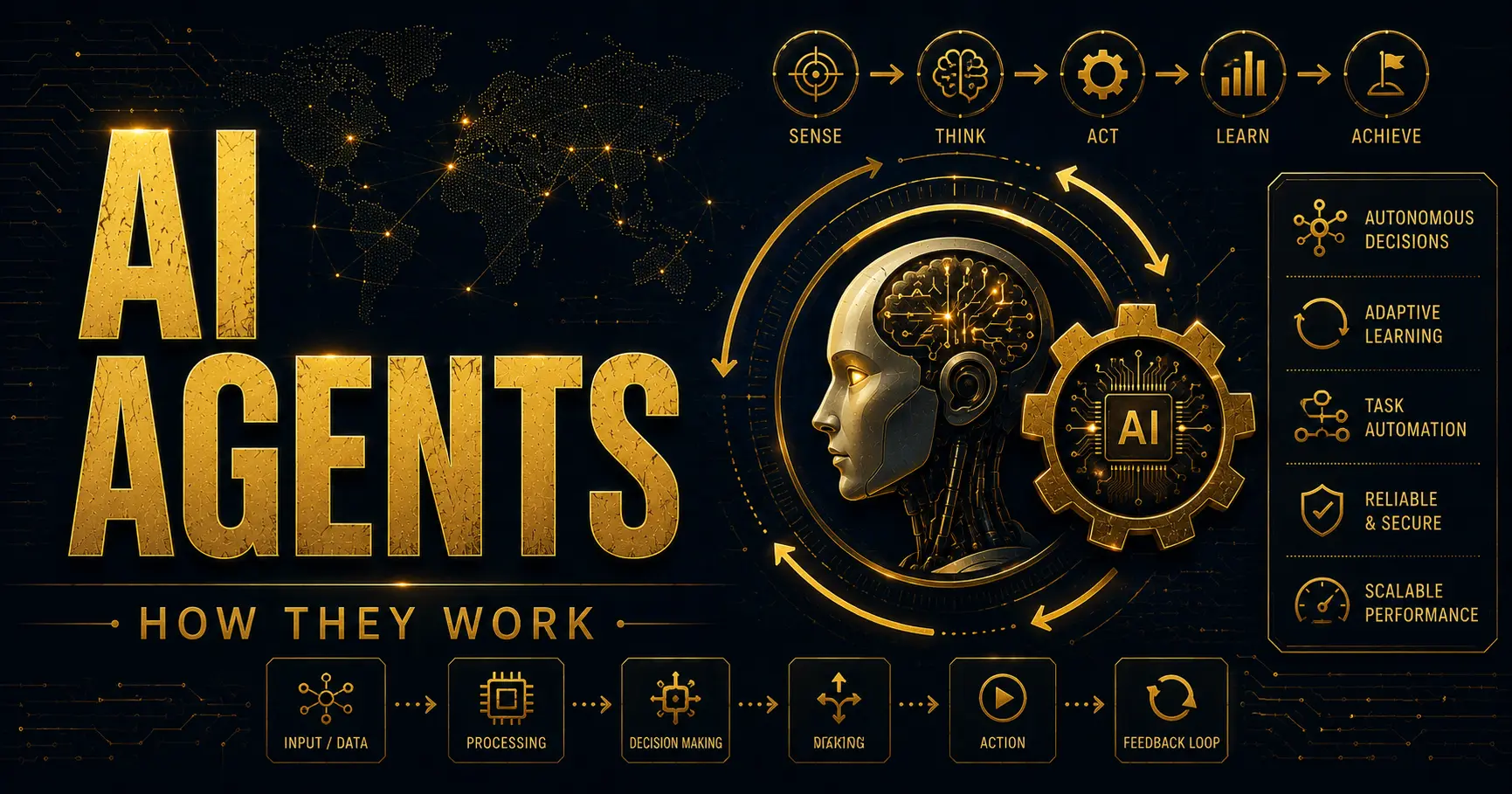
AI agents represent a fundamentally different approach. Rather than responding to a single input and producing a single output, an agent takes a goal, breaks it down into tasks, uses tools to gather information and take actions, evaluates results, and iterates until the goal is achieved.
The difference between a tool and an agent is the difference between a calculator and an assistant who can research, plan, execute, and report back.
To understand how attackers use automation to bypass traditional security, read How to Defend Against AI-Powered Cyberattacks.
📌 Emergency Support: Already targeted by an advanced AI exploit or suspect a breach? Get instant, confidential expert help with our Emergency Incident Response & Forensic Investigation.
📌 Next-Gen Defense: Fight AI with AI—proactively protect your business with our Custom AI & Cyber Security Automation Services.
What is an AI Agent?
An AI agent is an autonomous system that perceives its environment, makes decisions, and takes actions to achieve a specified goal.
The term agent comes from the field of artificial intelligence research, where it has been used for decades to describe systems that act on behalf of users or other systems. What has changed recently is the capability of the underlying models and the availability of tools and frameworks that make building practical agents accessible.
A modern AI agent typically consists of several components working together:
The Language Model At the core of most contemporary AI agents is a large language model that provides reasoning capability. The model interprets instructions, plans approaches, evaluates results, and generates outputs.
Tools An agent without tools can only think. Tools give agents the ability to act. Tools can include web search, code execution, file reading and writing, API calls, database queries, email sending, and virtually any other capability that can be exposed through an interface.
Memory Agents need to remember context across multiple steps of a task. This can include short-term memory within a single session, long-term memory stored in a database, and the results of previous tool calls that inform subsequent decisions.
Planning Effective agents decompose complex goals into manageable subtasks, determine the order in which to address them, and adapt their approach based on what they discover along the way.
How Do AI Agents Work in Practice?
To make this concrete, consider a simple example: an agent tasked with researching a potential client company and preparing a briefing document.
A human doing this task would search the web for information about the company, visit their website, check their LinkedIn page, look for recent news, synthesize what they found, and write a document summarizing the key points.
An AI agent follows essentially the same process:
- The agent receives the goal: prepare a briefing on Company X
- It plans the approach: what information is needed and where to find it
- It uses web search tools to gather information from multiple sources
- It reads and processes the content it finds
- It synthesizes the information and identifies key points
- It generates a structured briefing document
- It reviews its output and refines it if necessary
This entire process can happen in minutes, without human intervention at each step.
Types of AI Agents
AI agents are not all the same. They vary significantly in their architecture, capability, and the types of tasks they are suited for.
Single-Agent Systems
A single agent handles the entire task from start to finish. This works well for focused, well-defined tasks where the scope is limited and the tools required are straightforward.
Multi-Agent Systems
Complex tasks often benefit from multiple specialized agents working together. A multi-agent system might include a research agent, an analysis agent, and a writing agent, each focused on what it does best. An orchestrator agent coordinates their work and synthesizes their outputs.
This architecture mirrors how human teams work — specialists collaborating under coordination, each contributing their expertise to a shared goal.
Autonomous vs. Human-in-the-Loop Agents
Some agents operate fully autonomously, completing tasks from start to finish without human intervention. Others are designed to involve humans at key decision points — requesting approval before taking consequential actions, flagging uncertainty for human review, or presenting options for human selection.
The appropriate level of autonomy depends on the task, the stakes involved, and the reliability of the agent for that specific use case.
AI Agents in Cybersecurity
Cybersecurity is one of the domains where AI agents offer the most compelling value, for a simple reason: the volume of data and events that security teams must process far exceeds what humans can handle manually.
Threat Detection AI agents can continuously monitor security logs, network traffic, and endpoint telemetry, correlating signals across multiple sources to identify patterns that indicate a threat. Unlike rule-based systems, agents can reason about novel combinations of indicators and explain their conclusions.
Incident Triage When an alert fires, an agent can automatically gather context — pulling relevant logs, checking threat intelligence feeds, identifying affected systems, and assessing impact — before a human analyst reviews the case. This dramatically reduces the time from alert to informed response.
Threat Intelligence Agents can continuously gather and synthesize threat intelligence from multiple sources, producing structured reports on emerging threats relevant to your organization and industry.
Security Research Agents can assist security researchers with tasks like malware analysis, vulnerability research, and reverse engineering, handling routine aspects of the work and allowing human experts to focus on the most complex and novel problems.
AI Agents in Business Operations
Beyond cybersecurity, AI agents are transforming how businesses operate across a wide range of functions.
Sales and Lead Generation Agents can identify potential customers, qualify leads based on defined criteria, research prospects, and draft personalized outreach messages — enabling sales teams to focus on relationships and closing rather than research and prospecting.
Customer Support Agents trained on product documentation and support history can handle routine customer queries, escalating to human agents only when the query requires judgment or authority beyond the agents capability.
Research and Analysis Any task that involves gathering information from multiple sources, synthesizing it, and producing a structured output is a candidate for agent automation. Market research, competitive analysis, regulatory monitoring, and due diligence are all examples.
Process Automation Agents can handle multi-step business processes that previously required human coordination — scheduling, data entry, report generation, approval workflows, and more.
The Limitations of AI Agents
It would be misleading to discuss AI agents without acknowledging their current limitations.
Reliability Agents can make mistakes, particularly on tasks they have not been specifically designed and tested for. The more complex and open-ended the task, the more likely the agent is to encounter situations where its reasoning fails.
Security Agents with broad access to systems and data introduce new attack surfaces. Prompt injection attacks, where malicious content in the environment manipulates agent behavior, are a real and active threat vector that security teams need to account for.
Oversight Fully autonomous agents operating without human oversight can take consequential actions based on incorrect reasoning. Designing appropriate oversight mechanisms is as important as building the agent itself.
Cost Running capable AI agents at scale involves significant API costs. For some use cases, the economics work clearly in favor of automation. For others, the math is less straightforward.
Building effective agents requires honestly assessing these limitations and designing systems that mitigate them.
What to Consider Before Building an AI Agent
If you are considering building or deploying an AI agent for your organization, start with these questions:
- What specific task or workflow are you trying to automate?
- What tools and data sources does the agent need access to?
- What is the appropriate level of human oversight for this use case?
- How will you evaluate whether the agent is performing correctly?
- What are the security implications of the access the agent requires?
A well-scoped, carefully designed agent for a specific use case will almost always outperform an ambitious but poorly defined general-purpose agent.
How ImrulLabs Can Help
At ImrulLabs, we design and build custom AI agents for both cybersecurity and business automation use cases. Whether you are looking to automate security operations, scale your sales outreach, or eliminate repetitive business processes, we build agents that actually work.
Get in touch to discuss what AI automation could look like for your organization.